YELLOW SUBMARINE
Apple PMCO 7070 (MONO) / PCSO 7070 (STEREO)
Apple PMCO 7070 (MONO) / PCSO 7070 (STEREO)
| FORMAT | RELEASE DATE | SIDE 1 MATRIX | SIDE 2 MATRIX | PARTS |
| MONO | 23 Jan 1969 | XEX 715-1 | XEX 716-1 | UK |
| STEREO | 23 Jan 1969 | YEX 715-1 | YEX 716-1 | UK |
| STEREO | Apr 1981 | YEX 715-2 OR | YEX 716-2 OR | AU |
| STEREO | 24 Aug 1987 | PCSO 7070 A-2 AP MASTERED ON COPPER |
PCSO 7070 B-2 AP MASTERED ON COPPER |
AU* |
| STEREO | 14 Nov 1988 | PCSO 7070D-A | PCSO7070D-B | AU |
| *Yellow vinyl pressing; mastered direct to copper. Only 2000 pressed | ||||
MATRIX INFORMATION
Machine Stamped - Hand Written
Machine Stamped - Hand Written
| ORIGIN | CODE | CIRCULATED | SLEEVE DETAILS |
| AUST | A1 | Jan 1969 | Mono + stereo catalogue numbers; flipback sleeve; front laminated |
| AUST | A2 | Dec 1969 | Stereo catalogue number only; non-flipback sleeve |
| AUST | A3 | Nov 1988 | "DIGITALLY REMASTERED" footer on rear cover |
SLEEVE INFORMATION
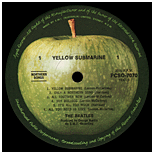
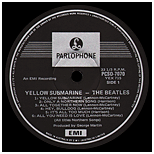
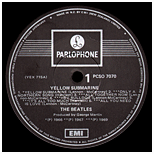
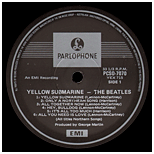
APPLE - Mono
AU7070M1
23 Jan 1969
AU7070M1
23 Jan 1969
APPLE - Stereo
AU7070S1A
23 Jan 1969
AU7070S1A
23 Jan 1969
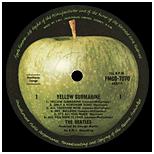
NZ DK GREY 1-BOX
AU7070S3
1981
AU7070S3
1981
BLACK 1-BOX B
AU7070S2B
Jul 1987
AU7070S2B
Jul 1987
BLACK 1-BOX A
AU7070S2A
Apr 1982
AU7070S2A
Apr 1982
GENERAL ALBUM INFORMATION
As per the UK release, Yellow Submarine was the last Beatles album to be released in Australia in mono (not actually a unique mono mix but a 'fold-down' of the stereo tapes).
Bruce Hamlin's book, The Beatles Records in Australia, states that only around 1300 copies of the mono edition were sold in Australia. As sales of mono albums had dropped significantly relative to stereo albums, EMI (Australia) had commenced deleting mono records, where there was a stereo alternative, from December 1968. Despite having such a limited production run, at least two mono label variations of Yellow Submarine were published.
The Acceptance Sheet for the Australian Yellow Submarine specifies the use of Parlophone labels; an error that was picked-up and corrected prior to production. It seems that the New Zealand acceptance sheet also specified Parlophone labels but the error went unnoticed and first NZ pressings of Yellow Submarine went out with Parlophone labels - this was despite the fact that The Beatles had already been issued on the Apple label.
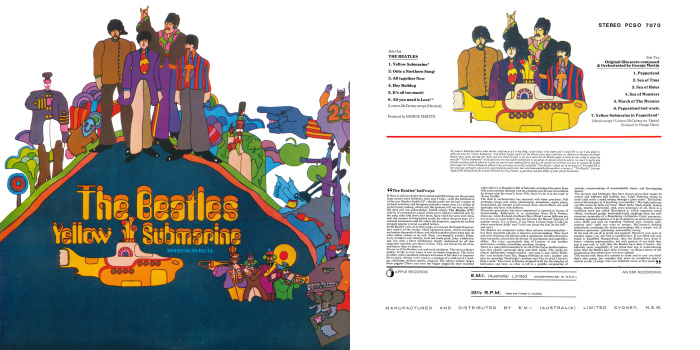
The Australian sleeve, while similar to the UK sleeve, has several distinctive differences:
1) A blue/green hill (UK = grey)
2) Font, colour and placement of the "NOTHING IS REAL" text, i.e. blue instead of green, and placed slightly more left.
3) The two 'Blue Meanies', at bottom-right, are grey instead of blue.
4) Rear-sleeve has one red horizontal line (reconstructed locally) and one black line (red on the UK sleeve).
5) Derek Taylor's italicised blurb is horizontally centred (at left on UK sleeve).
Sometime around early 1987, a number of sleeves were printed with an obvious printing error. On these sleeves the entire artwork, front and back, was shifted up about 1.5cm, resulting in John's arm and head being partially cut off and a white band across the bottom of the sleeve. The error did not appear on subsequent print runs.
1987 YELLOW VINYL EDITION
For the 1987 'yellow vinyl' release, Allan Parsons took the original analogue production master tapes and transferred to beta tape using a Sony PCM-701 digital converter. The Sony PCM-701 was an early consumer format, inferior to 1610/1630, and was how digital was created at EMI at that time.
While transferring, it can be assumed that Allan re-EQ'd and processed with dynamic range enhancer (there was a dbx 3BX in the rack). In essence, that makes this (and the 'white vinyl' The Beatles) true locally-produced digital remasters, just not sanctioned by EMI UK. Please visit The Beatles "Production Master Tape" page for more information.
The album was mastered direct to copper (essentially DMM but with minor modifications) and pressed by Festival Records (as EMI (Australia) didn't press coloured vinyl) and released on 24 August 1987. It sounded rather substandard and today is nothing more than a collector's piece valued for its yellow vinyl. Notwithstanding, upon its reissue the album spent 7 weeks on the charts, reaching #53, albeit mainly off the back of the CD.
Once the yellow vinyl run was completed, EMI (Australia) went back to pressing the album on black vinyl, using Allan's masters, until being replaced by the digital remasters in late 1988.
Bruce Hamlin's book, The Beatles Records in Australia, states that only around 1300 copies of the mono edition were sold in Australia. As sales of mono albums had dropped significantly relative to stereo albums, EMI (Australia) had commenced deleting mono records, where there was a stereo alternative, from December 1968. Despite having such a limited production run, at least two mono label variations of Yellow Submarine were published.
The Acceptance Sheet for the Australian Yellow Submarine specifies the use of Parlophone labels; an error that was picked-up and corrected prior to production. It seems that the New Zealand acceptance sheet also specified Parlophone labels but the error went unnoticed and first NZ pressings of Yellow Submarine went out with Parlophone labels - this was despite the fact that The Beatles had already been issued on the Apple label.
The Australian sleeve, while similar to the UK sleeve, has several distinctive differences:
1) A blue/green hill (UK = grey)
2) Font, colour and placement of the "NOTHING IS REAL" text, i.e. blue instead of green, and placed slightly more left.
3) The two 'Blue Meanies', at bottom-right, are grey instead of blue.
4) Rear-sleeve has one red horizontal line (reconstructed locally) and one black line (red on the UK sleeve).
5) Derek Taylor's italicised blurb is horizontally centred (at left on UK sleeve).
Sometime around early 1987, a number of sleeves were printed with an obvious printing error. On these sleeves the entire artwork, front and back, was shifted up about 1.5cm, resulting in John's arm and head being partially cut off and a white band across the bottom of the sleeve. The error did not appear on subsequent print runs.
1987 YELLOW VINYL EDITION
For the 1987 'yellow vinyl' release, Allan Parsons took the original analogue production master tapes and transferred to beta tape using a Sony PCM-701 digital converter. The Sony PCM-701 was an early consumer format, inferior to 1610/1630, and was how digital was created at EMI at that time.
While transferring, it can be assumed that Allan re-EQ'd and processed with dynamic range enhancer (there was a dbx 3BX in the rack). In essence, that makes this (and the 'white vinyl' The Beatles) true locally-produced digital remasters, just not sanctioned by EMI UK. Please visit The Beatles "Production Master Tape" page for more information.
The album was mastered direct to copper (essentially DMM but with minor modifications) and pressed by Festival Records (as EMI (Australia) didn't press coloured vinyl) and released on 24 August 1987. It sounded rather substandard and today is nothing more than a collector's piece valued for its yellow vinyl. Notwithstanding, upon its reissue the album spent 7 weeks on the charts, reaching #53, albeit mainly off the back of the CD.
Once the yellow vinyl run was completed, EMI (Australia) went back to pressing the album on black vinyl, using Allan's masters, until being replaced by the digital remasters in late 1988.
PAGE LAST UPDATED: 20 AUGUST 2026