A Short Overview of Local Manufacture
By the mid-1920s, demand for gramophone records in Australia had grown to the point where adequate supply could no longer be maintained from overseas. In response, The Gramophone Company Ltd, of England, opened a 40,000 square foot gramophone and record plant at Erskineville, Sydney, on 18 January 1926. The plant employed 400 staff, together with a manager and 12 department heads brought from the UK, and manufactured His Master's Voice gramophones and records for the Australian and New Zealand markets.
Nine months later, on 14 October 1926, its rival, Columbia Graphophone Company Ltd—through its Australian subsidiary, Columbia Graphophone (Australia) Ltd—officially opened a new 50,000 square foot plant at Homebush, Sydney, employing 350 staff.
Following the onset of the Great Depression, The Gramophone Company Ltd and Columbia Graphophone Company Ltd, including its subsidiary The Parlophone Company Ltd, merged in the UK to form Electric and Musical Industries Ltd, better known as EMI UK, on 20 March 1931. In Australia, the three local branches were brought together under one administrative control as the "associated manufacturers", with record production centralised at the Homebush factory from July 1931.
EMI (Australia) Ltd was formed as a proprietary company in 1948 to take over the activities previously carried out by the Australian branches of the English companies. The group's headquarters were located in the company's eight-storey "Emitron House" at 301 Castlereagh Street, Sydney. EMI (Australia) converted to a public company in May 1957.
By 1963, EMI (Australia) was manufacturing and distributing a wide range of products, including television receivers, domestic radio receivers, radiograms, car radio receivers, domestic electrical appliances and, of course, gramophone records. At this time, EMI (Australia) was pressing records through its three major house labels—HMV, Columbia and Parlophone—as well as on behalf of Decca Records in the UK.
All product manufacture was carried out at the Homebush factory, which was progressively extended to keep pace with the company's expanding and increasingly diverse interests. Homebush would remain EMI (Australia)'s principal manufacturing and distribution centre for nearly 65 years, until closing its doors in November 1990.
The Homebush plant originally incorporated 20 of the most modern record presses then available. Imported directly from the UK and configured by British engineers, the presses were collectively capable of producing 11 million records a year. This reliance on UK-sourced expertise and equipment continued throughout the company's history. By the time The Beatles were reverberating through Australian speakers in the 1960s, the Homebush plant was using pressing equipment similar to that used to manufacture Beatles records at Hayes, Middlesex.
As a subsidiary of EMI UK, EMI (Australia) received advance notice of forthcoming UK releases and could choose to import copies, manufacture them locally, or pass on them altogether — the latter generally only an option if the release had not charted strongly in the UK. EMI (Australia) primarily manufactured Beatles records locally, issuing them through its Parlophone label.
In addition to releasing the core UK Beatles catalogue, EMI (Australia) exercised its discretion to issue a number of locally conceived Beatles records. The company quickly learned that, where The Beatles were concerned, more releases were better than fewer. Between 1963 and 1970, EMI (Australia) released 30 singles, 18 of which were double A-sides, 18 EPs and 17 LPs. By comparison, EMI UK released 22 singles, 13 EPs and 13 LPs over the same period.
UK Parlophone LPs added to the Australian Parlophone catalogue retained their UK catalogue numbers, but with the Australian country code "O" suffixed to the mono and stereo prefix codes. For example, PMC 1202 was catalogued locally as PMCO 1202. LPs issued locally by Parlophone that were not part of the UK Parlophone catalogue used a separate Australian catalogue number range, beginning at PMCO/PCSO 7500.
EMI (Australia) pressed both mono and stereo LPs throughout the 1960s, until declining sales led to the deletion of mono LPs—where stereo alternatives existed—in June 1969. By that time, the mono releases of The Beatles and Yellow Submarine had sold only around 5,000 and 1,300 copies respectively.
Pre-recorded cassettes were manufactured locally from 1970, followed by 8-track cartridges from mid-1972. Please visit the "Other Formats…" section for more information on these formats. All Beatles LPs were released in both cassette and 8 track cartridge format. As in the UK, it was possible—and quite likely—for the cassette or 8 track cartridge version of a title to have been mastered from a different set of tapes than its vinyl equivalent.
Like LPs, UK Parlophone extended plays added to the Australian Parlophone catalogue retained their UK catalogue numbers, but with "O" suffixed to the "GEP" prefix code. EPs issued locally by Parlophone that were not part of the UK Parlophone catalogue, including UK titles with locally modified track lists, used a separate Australian catalogue number range beginning at GEPO 70001.
Singles released in Australia on the Parlophone label were allocated numbers in the 8000 range, beginning with the letter "A". From A8083 onward, all Parlophone single numbers ending in "3" were either used by, or reserved for, The Beatles. In March 1968, EMI (Australia) ended the separate cataloguing systems used for its in-house and distributed labels and introduced a unified numbering system beginning at 8301. The 8000 series was chosen because Parlophone's catalogue—the highest range then in use—had by that time reached the low 8000s. 'Lady Madonna'/'The Inner Light' was the last Parlophone single issued under the old numbering system.
Over the years, EMI (Australia) continued to refine, enhance and adapt its manufacturing processes in order to remain current and competitive. Please visit the links above for examples of some of these initiatives.
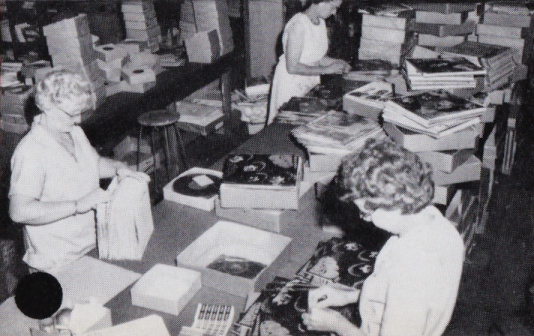
You can see the boxes that house the records - there's quite a few at the back and under the bench!
The lady on the left is sifting through a bundle of sleeves, while the lady at the bottom right is placing stereo stickers on her batch of sleeves; you can see the stickers on the table in front of her. The lady in the background appears to be doing the same.
In the background left there appears to be bundles of 7" records in generic EMI sleeves.
The key takeaway from this photo is the disorganisation - boxes all around. It perfectly explains the randomness of the numbered sleeves for The Beatles. It perfectly explains why late 1969 copies of Sgt Pepper's Lonely Hearts Club Band could still be housed in UK sleeves, even though the Aussie sleeve was available. The ladies just grabbed boxes of each, whatever boxes were in front of them, and away they went. When finished, they packed the records into boxes of 25 then off to warehousing.
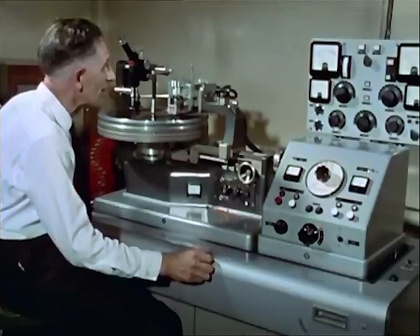
The lathe dates to the 1950s, and may have been installed when EMI (Australia) transferred its recording operations from Homebush to 301 Castlereagh Street in 1954.
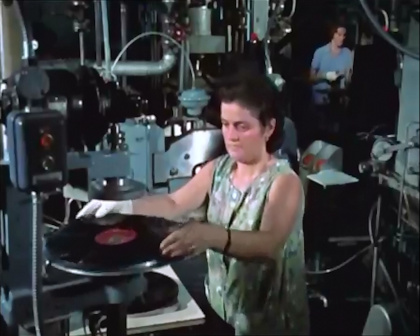
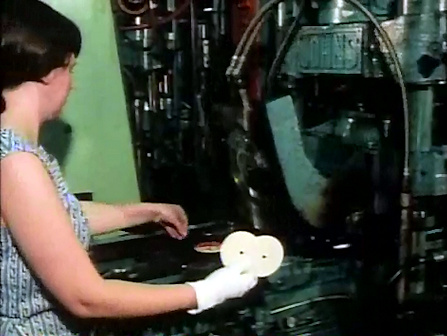
The photo below left shows an employee pressing records at EMI (Australia)'s Homebush factory, early 1969, while the photo below right shows one of EMI (Australia)'s Johns presses in action, 1979, just prior to the installation of new Toshiba-EMI automatic presses. The Australian-made Johns manual hydraulic press was the workhorse of EMI (Australia), being in operation since the late 1950s.