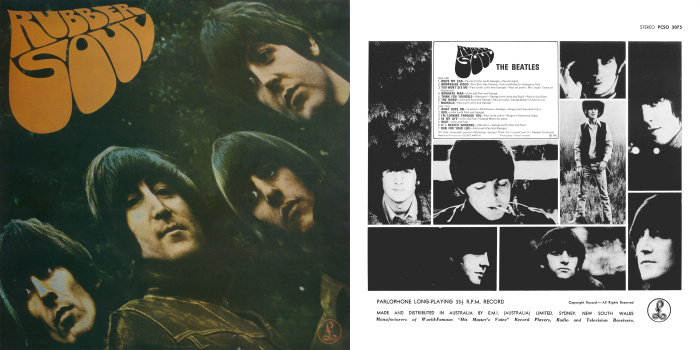
RUBBER SOUL
Parlophone PMCO 1267 / PCSO 3075
Released 17 February 1966
Original recommended retail price: $5.25
Released in Australia on 17 February 1966, Rubber Soul retained the British cover design despite local reproduction difficulties, leaving a distinctive loss of photographic detail on Australian sleeves.
Labels & Related Material
AULP1267YBM
February 1966
AULP3075BS
February 1966
AULP1267NZCB
1967/68
AULP3075YBS
February 1969
AULP3075OA
Q2 1969
AULP3075OB
October 1978
AULP3075NZCC
January-June 1981
AULP3075SBA
April 1982
AULP3075SBB
July 1987
Tracks
Same tracks as UK release
Pressing & Mastering

Format

First Issued

Side 1

Side 2

Parts

Mono

17-Feb-66

XEX 579-1

XEX 580-1

UK*

Stereo

17-Feb-66

YEX 178-2

YEX 179-2

UK

Stereo

~67

YEX 178-3

YEX 179-3

UK

Stereo

Early 72

YEX 178-2

YEX 179-3

UK

Stereo

~72

YEX 178-3

YEX 179-3

UK

Stereo

~72

YEX 178-3

YEX 179-3

AU

Stereo

Mar-79

YEX 178-3

YEX 179-5

AU

Stereo

82

YEX 178-3

YEX 179-3

AU/UK

Stereo

16-Jun-83

✎YEX 178-4 AP

✎YEX 179-6 AP

AU

Stereo

19-Dec-88

PCSO 3075D-A

PB EMIDISC DMM

PCSO 3075D-B

PB EMIDISC DMM

AU

* Popularly referred to as the loud cut; quickly replaced by 579-4 / 580-4 in the UK but retained in Australia.

A somewhat confusing list for stereo pressings! It appears that around 1967, EMI (Australia) introduced UK -3/-3 cuts then reverted side 1 back to the UK -2 cut in the early 1970s. Around 1972 both sides were recut locally, retaining the -3/-3 lacquer numbers. Perhaps EMI (Australia) was confused, but subsequent pressings up until 1983 have been confirmed with either UK, AU, or a mix of both, -3 cuts. An Australian cut can be identified by a taller and narrower font than that used on original UK pressings.
Sleeve Information

Code

Circulated

Comments

AU1

Feb-66

Mono + stereo catalogue numbers; flipback sleeve

AU2

Dec-69

Stereo catalogue number only; non-flipback sleeve

AU3

Dec-88

"DIGITALLY REMASTERED" footer on rear cover

Overview
By the time Rubber Soul was prepared for Australian release, EMI UK had very sternly cautioned EMI (Australia) over its unauthorised replacement of the Beatles for Sale sleeve. A further local redesign was therefore no longer an option, even though reproducing the British artwork remained difficult.

The Australian edition retained the original cover image, but its reproduction was noticeably inferior from the first issue and appears to have deteriorated on later pressings. The problem is particularly apparent across the bridge of George Harrison’s nose, where an overexposed “hot spot” removes almost all photographic detail.

The precise cause is uncertain. It may have originated in the photographic copying of the artwork, the printing process, or a combination of both. Whatever the explanation, the sleeve illustrates the practical difficulties EMI (Australia) faced when required to reproduce an overseas design using local production methods.