SGT. PEPPER'S LONELY HEARTS CLUB BAND
Parlophone PMCO 7027 / PCSO 7027
Parlophone AUDIO-5
Released 28 July 1967
Original recommended retail price: $5.25
Delayed in Australia in 1967 by a shipment of imported sleeves, Sgt. Pepper’s Lonely Hearts Club Band developed a distinctive local history encompassing British packaging, an acclaimed 1983 audiophile edition and Festival’s half-speed-mastered red-vinyl anniversary release in 1987.
Labels & Related Material
AULP7027YBM
July 1967
AULP7027BS
July 1967
AULP7027YBS
February 1969
AULP7027OA
Q3 1969
AULP7027OB
October 1978
AULP7027OC
Early 1979
AULP7027NZCC
January-June 1981
AULP7027SBA
April 1982
AULPAUDIO5
July 1983
AULP7027SBB
July 1987
Tracks
Same tracks as UK release
Pressing & Mastering

Format

First Issued

Side 1

Side 2

Parts

Mono

28-Jul-67

XEX 637-1

XEX 638-1

UK

Stereo

28-Jul-67

YEX 637-1

YEX 638-1

UK

Stereo

25-Oct-82

YEX 637-1

✎YEX 638-2 OR

UK/AU

Stereo

25-Oct-82

✎YEX 637-2 OR

✎YEX 638-2 OR

AU

Stereo

1-Jul-83

✎AUDIO 5-A -3 DB

✎AUDIO-5-B DB

AU*

Stereo

1-Jun-87

✎PCSO-7027-A

AMX-67841-YEX-638 W2B

✎PCSO-7027

AMX-67842 W2C

AU**

Stereo

1-Jun-87

✎PCSO-7027-A

AMX-67841-YEX-638 W2B2

✎PCSO-7027

AMX-67842 W2C

AU**

Stereo

1-Jun-87

✎PCSO-7027-A

AMX-67841-YEX-638 W2B2

✎PCSO-7027

AMX-67842 W2C2

AU**

Stereo

Aug-87

✎PCSO-7027-A

AMX-67841-YEX-638 W2B

✎PCSO-7027

AMX-67842 W2

AU**

Stereo

Aug-87

✎PCSO-7027-A

AMX-67841-YEX-638 W2B

✎PCSO-7027-B1

AMX-67842 YEX-639 W2C

AU**

Stereo

Aug-87

✎PCSO-7027-A

AMX-67841-YEX-6387 W2B

✎PCSO-7027B

AMX-67842 W2C YEX 638

AU**

Stereo

Aug-87

✎YEX 637-2 OR

✎PCSO-7027B

AMX-67842 W2C YEX 638

AU

Stereo

19-Dec-88

✎PCSO 7027 D-A

✎PCSO 7027 D-B

AU

* Masters created for extremely limited 1983 Audiophile reissue.
** Masters/mothers created for 1987 red vinyl reissue; cut at Festival Records by Warren Barnett as EMI (Australia) did not have the wherewithal to press coloured vinyl. Some audiophiles insist that this pressing is every bit the sonic/aural equal of the 1983 Audiophile pressing. The mothers continued to be used by EMI (Australia) after the coloured vinyl run was completed, until being replaced by the digital remasters in late 1988.
Sleeve Information

Code

Circulated

Comments

UK1

Jul-67

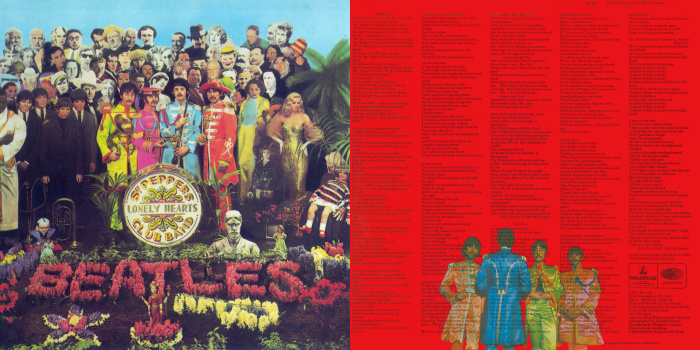
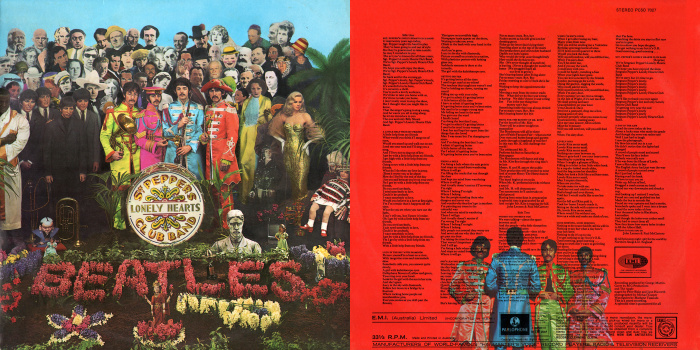
Imported UK mono g/fold sleeve; wide spine; "Patents Pending"; cutout sheet and "Fool" inner sleeve

UK2

Jul-67

Imported UK stereo sleeve; wide spine; cutout sheet and "Fool" inner sleeve

UK3

68

Imported UK mono sleeve; normal spine; cutout sheet and "Fool" inner sleeve

UK4

68

Imported UK stereo sleeve; normal spine; cutout sheet and "Fool" inner sleeve

UK5

Mar-69

Same as UK4, but with black/white STEREO sticker affixed top left

AU1

Dec-69

Single-pocket; no cutout sheet or "Fool" inner sleeve; early sleeves laminated, then unlaminated

AU2

79

Similar to AU1 but with different footer text on rear sleeve

AU3

Jul-87

G/fold with cutout sheet. Rear-cover footer manufacture credits at right

AU4

Dec-88

G/fold with cutout sheet; "DIGITALLY REMASTERED" footer on rear cover; rear-cover footer manufacture credits at left, with larger 'EMI' logo than AU3

Overview
A delayed arrival and an immediate rush
The Australian arrival of Sgt. Pepper’s Lonely Hearts Club Band depended as much on shipping as on record manufacture. Reproducing the elaborate British gatefold locally was not possible at the time, so EMI (Australia) ordered finished sleeves from Britain instead.

In early May 1967, EMI UK dispatched 50,000 sleeves for Australia, together with an uncertain quantity intended for HMV New Zealand—anecdotally around another 5,000. The shipment encountered escalating tensions in the Middle East and was diverted around the Cape of Good Hope. Approximately eighteen additional days at sea removed any prospect of an Australian release during June.

The original ambition had been a simultaneous worldwide release on 1 June. Britain itself upset that schedule by releasing the album early, but Australia faced a substantially longer wait. HMV New Zealand subsequently abandoned its imported allocation and manufactured sleeves locally, probably influenced by the country’s tight import restrictions. Its unused British sleeves were redirected to Australia.

Australian review copies began reaching the press towards the end of July, although some reviewers had independently obtained British copies. Northern Songs, the local publisher for all the album’s tracks, instructed the Australian Performing Rights Association to restrict performance of all twelve tracks until 27 July.

When the album finally went on sale on Friday, 28 July, demand was immediate. Melbourne's The Age newspaper reported on 3 August that record stores across Melbourne had quickly run out of copies despite having stocked heavily in anticipation. EMI (Australia) was kept busy replenishing dwindling supplies, while some retailers remarked on the unusually broad range of buyers: some were older customers not normally associated with Beatles records, while a notable number identified themselves as musicians who “simply had to take the record home to play”.  The paper suggested the album appeared to be heading for record-breaking sales.

Radio exposure was substantial but not unrestricted. The Federation of Commercial Broadcasting Stations had banned 'A Day in the Life' and advised stations to treat 'Lucy in the Sky with Diamonds' with reserve. Melbourne stations 3DB, 3XY and 3AK were nevertheless reported to be playing the remainder of the album, while the programming policies of 3KZ and 3UZ limited the number of tracks they could broadcast. An ABC spokesman indicated that the album’s “reasonably tuneful” songs would be heard on the First Network.

EMI (Australia) followed the release with “Beatles Week” from Monday, 31 July, combining dealer displays with television, radio and newspaper competitions across the country.

Sales quickly justified the effort. Within months, EMI (Australia) was approaching the end of its initial sleeve supply and requested more. By February 1968, approximately 80,000 copies had sold, all in imported British covers.

Surviving examples suggest that the second shipment introduced some German-made candy-striped inner sleeves, although this conclusion rests on observation and research rather than definitive EMI (Australia) paperwork. British outer sleeves remained in use into 1969, and ambiguous records leave open the possibility of another shipment after the second.

When stereo sleeve stocks ran out in February 1969, EMI (Australia) used its remaining mono covers for stereo records. A locally manufactured sleeve finally appeared in December, replacing the gatefold with a simpler single-pocket design. Existing stocks meant that imported and Australian sleeves continued circulating together into early 1970.

This reliance on British packaging produced a reversal of overseas rarity. The “widespine” sleeve, identifiable partly by its rear-cover “Patents Pending” wording, is uncommon and expensive in Britain but is the most frequently encountered original variation in Australia. The contrast has extended to prices: British examples can command hundreds of pounds, while Australian-market copies have sometimes been found for around AU$40, less than £20.

The album also made unusual appearances on singles charts, reaching No. 12 in Perth during nine weeks and No. 40 on the national Go-Set chart during two weeks.

The 1978 revival
Michael Schultz’s 1978 film Sgt. Pepper’s Lonely Hearts Club Band, starring Peter Frampton and the Bee Gees, brought renewed attention to the original album. EMI (Australia) supported a national campaign, issued the related single A-12000 and imported the British picture-disc LP. The album returned to the Australian charts in September, reaching No. 30 during fifteen weeks.

The 1983 Audiophile edition
The 1983 Audiophile pressing warrants separate treatment. Its dedicated Audiophile Pressing and Production Master Tape pages explain that edition and its source tapes.

The twentieth anniversary: 1987
The album’s twentieth anniversary coincided with the rapid growth of compact disc. During 1987, EMI introduced The Beatles’ catalogue on CD in stages, scheduling Sgt. Pepper’s for 1 June and promoting it internationally as “the most important record ever released on compact disc”.

For Australia, the anniversary carried an irony. The original album had missed the intended international date by roughly two months; the 1987 CD and red-vinyl edition therefore celebrated the date Australians should have received it twenty years earlier.

This time, supply was ready—but demand was greater still. All 15,000 imported CDs reportedly sold by the end of release day, an Australian record at the time, prompting urgent orders for additional British stock. The long-awaited arrival of The Beatles on CD and the familiar “It was twenty years ago today” anniversary message made the album the natural centrepiece of the campaign.

Vinyl buyers received their own special edition. EMI (Australia) commissioned a limited red-vinyl pressing but, reluctant to manufacture coloured records itself because of perceived quality disadvantages, contracted the work to Festival Records. Please visit the Coloured Vinyl page to read more about this release.

Demand prompted another pressing run within approximately the first week, according to EMI (Australia) A&R Manager Rob Walker. Festival ultimately pressed just over 9,000 coloured copies. Colour varied between batches, with some early records distinctly pink rather than the deeper red usually associated with the release.

The discs used standard EMI (Australia) labels. Early copies came in the familiar Australian single-pocket sleeve, bearing a “SPECIAL LIMITED EDITION IN COLOURED VINYL” sticker. At least three sticker variations are known; examples appear on the Coloured Vinyl page.

Meanwhile, EMI (Australia) was preparing the first locally manufactured gatefold sleeve for the album. Evidence suggests it may have been available by the 1 June launch, although existing single sleeves were apparently used first. A glimpse of the transition survives in the “Humdrum” segment of Countdown, broadcast on 31 May 1987: Molly Meldrum displayed the red LP in a single sleeve, but with the familiar cut-out insert inside. The full segment appears on the Promotional Material page.

Whether that was a specially assembled promotional copy is unknown. Commercial single-sleeve copies containing the insert also survive. As older sleeve stocks ran out, the new gatefold entered circulation and had become standard by July, midway through the coloured pressing run. The anniversary release therefore exists in two principal presentations: the earlier single sleeve and the later Australian gatefold with cut-outs.

The gatefold remained standard until local vinyl manufacture ended in late 1990. Anniversary publicity and the CD launch also returned the album to No. 4 during a twenty-one-week chart run, although most sales were almost certainly CDs rather than the comparatively limited coloured LP.

The Festival mastering’s continuing life
Festival’s work outlasted the red-vinyl release. EMI (Australia) used the same masters for subsequent black pressings, later reverting side one to Otto Ruiter’s 1982 -2 cut while retaining Festival-derived parts for side two. These hybrid combinations remained possible until the introduction of Allan Parsons’ digitally sourced cuts, made over 12–13 November 1988.

The Festival mastering has earned a reputation beyond its anniversary presentation. Because Warren and Don Bartley seemingly worked from the same 30 ips tapes, comparison with the Audiophile edition is inevitable. To the webmaster's ears, Warren’s cut is equally accomplished, although Don’s has somewhat fuller bass, perhaps reflecting the freedom he received to adjust equalisation. Whether Warren had the same latitude is unknown; if he stayed closer to the tape, his version may offer a more literal presentation of the production masters.

The price difference reinforces its appeal. The scarce Audiophile edition has commanded around $2,000, compared with roughly $100 for a good red Festival pressing and considerably less for later black copies using the same mastering. Those comparisons explain its reputation as the “poor man’s audiophile version”.