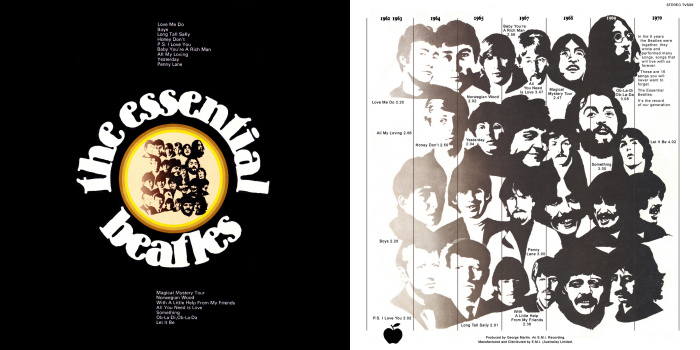
THE ESSENTIAL BEATLES
Apple TVSS8
Released 2 February 1972*
Original recommended retail price: $3.99
Released as a budget-priced loose celebration of The Beatles’ tenth anniversary, The Essential Beatles compiled sixteen of their biggest local hits and remained a popular catalogue title well into the 1980s.

*This long-accepted date remains unverified and may not be correct
Labels & Related Material
Tracks

Side 1

Side 2

1. Love Me Do

1. Magical Mystery Tour

2. Boys

2. Norwegian Wood

3. Long Tall Sally

3. With A Little Help From My Friends

4. Honey Don't

4. All You Need Is Love

5. P.S. I Love You

5. Something

6. Baby You're A Rich Man

6. Ob-La-Di, Ob-La-Da

7. All My Loving

7. Let It Be

8. Yesterday


9. Penny Lane


Pressing & Mastering

First Issued

Side 1

Side 2

Parts

2-Feb-72

✎YAPAX1071-3

✎YAPAX 1072.2 CQ

AU

2-Feb-72

✎YAPAX1071-3B

✎YAPAX 1072.2 CQ

AU

2-Feb-72

✎YAPAX1071-3

✎YAPAX 1072.2B CQ

AU

2-Feb-72

✎YAPAX1071-3B

✎YAPAX 1072.2B CQ

AU

2-Feb-72

✎YAPAX1071-3

✎YAPAX 1072.2C CQ

AU

2-Feb-72

✎YAPAX1071-3B

✎YAPAX 1072.2C CQ

AU

Aug-79

✎YAPAX1071-3B

YAPAX 1072-3 TVSS 8

AU

82

✎YAPAX1071-3C

YAPAX 1072-3 TVSS 8

AU

The 3/3B/3C and 2/2B/2C are not recuts, just different mothers, as the etching of the matrices is otherwise identical. Also, each side was cut by a different cutting engineer, with side 2 being cut by Clive Lipman
Sleeve Information

Code

Circulated

Comments

AU1

Feb-72

Front laminated

Overview
Few Australian Beatles albums have been more misunderstood overseas than The Essential Beatles. Issued in February 1972 at the budget price of $3.99, its seemingly unusual selection made perfect sense to Australian listeners. All sixteen tracks except “With a Little Help from My Friends” had reached at least the Sydney Top 3, and thirteen—including 'Honey Don’t'—had reached No. 1. Rather than an arbitrary collection, it was a distinctly Australian greatest-hits album and a loose celebration of The Beatles’ tenth anniversary.

The initiative was local, and proceeded without the necessary overseas approval, as Warren Barnett, then a young EMI (Australia) employee, later recalled:

“The great faux pas was The Essential Beatles. EMI (Australia) didn’t get permission from Apple, or anybody else, to do it — they just went ahead, put it on the Apple label and promoted it as a television-advertised album. EMI in the UK absolutely went troppo!”

That reaction has helped fuel the claim that the album was withdrawn or quickly deleted. Its actual history tells a different story. Heavily promoted on radio and television as part of EMI (Australia)’s “TV” series, it spent fourteen weeks on the charts and reached No. 10. It also survived the arrival of the internationally standardised 1962–1966 and 1967–1970 compilations in 1973, remaining available intermittently well into the 1980s.

In August 1980, the World Record Club included it in its Superstars of the 70’s box set, SSB 1–6. In February 1983, EMI coupled it with Barry Miles’ The Beatles in Their Own Words (London: Omnibus Press, 1978) to create The Beatles Sight & Sound. Having weathered more than a decade of overseas compilations, it was eventually superseded by another Australian collection: The Number Ones, issued in May 1983.

The album also reached New Zealand through a joint arrangement between EMI (NZ) Ltd and Music for Leisure Ltd—not Music for Pleasure. Both EMI and Phonogram pressed New Zealand copies using mothers supplied from Australia.

The Sydney hits behind the selection: Side one comprised 'Love Me Do' (No. 1), 'Boys' (No. 1, Requests EP), 'Long Tall Sally' (No. 1, Requests EP), 'Honey Don’t' (No. 1), 'P.S. I Love You' (No. 1, All My Loving EP), 'Baby You’re a Rich Man' (No. 1), 'All My Loving' (No. 1, All My Loving EP), 'Yesterday' (No. 3) and 'Penny Lane' (No. 1). Side two comprised 'Magical Mystery Tour' (No. 2), 'Norwegian Wood (This Bird Has Flown)' (No. 1), 'With a Little Help from My Friends' (no applicable chart placing), 'All You Need Is Love' (No. 1), 'Something' (No. 1), 'Ob-La-Di, Ob-La-Da' (No. 1) and 'Let It Be' (No. 1).

The album’s development was itself an interesting process, explored on the Production Master Tape page. Further details of its advertising campaign appear on the Promotional Material page.