THE BEATLES GREATEST HITS VOLS 1 & 2
Parlophone PCSS 7533/4
Released 22 February 1973
Original recommended retail price: $9.00
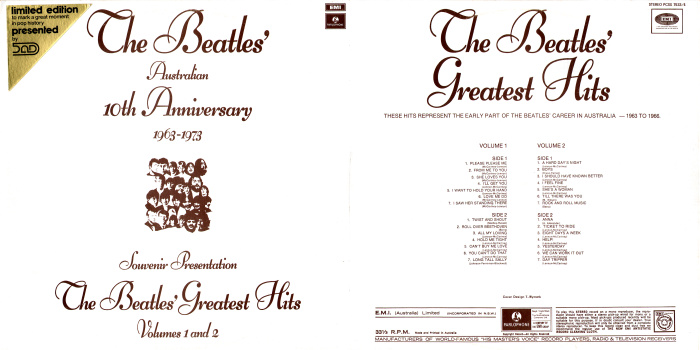
Released in February 1973 to mark the tenth anniversary of The Beatles’ first Australian release, this limited-edition double album repackaged the two locally compiled Greatest Hits volumes in a distinctive gatefold sleeve as part of a nationwide radio promotion.
Labels & Related Material
AULP7533PT
February 1973
Tracks

Side 1

Side 2

1. Please Please Me

1. Twist and Shout

2. From Me To You

2. Roll Over Beethoven

3. She Loves You

3. All My Loving

4. I'll Get You

4. Hold Me Tight

5. I Want To Hold Your Hand

5. Can't Buy Me Love

6. Love Me Do

6. You Can't Do That

7. I Saw Her Standing There

7. Long Tall Sally

Side 1

Side 2

1. A Hard Day's Night

1. Anna

2. Boys

2. Ticket To Ride

3. I Should Have Known Better

3. Eight Days A Week

4. I Feel Fine

4. Help!

5. She's A Woman

5. Yesterday

6. Till There Was You

6. We Can Work It Out

7. Rock and Roll Music

7. Day Tripper

Pressing & Mastering

First Issued

Side 1

Side 2

Side 3

Side 4

Parts

Feb-73

✎YAPAX 1015

✎YAPAX 1016

✎YAPAX 1009

✎YAPAX 1010

AU

Sleeve Information

Code

Circulated

Comments

AU1

Feb-73

Gatefold sleeve; gold sticker with name of distributing radio station

Overview
In 1972, EMI UK considered marking The Beatles’ tenth anniversary with a specially boxed collection, but the former Beatles quickly rejected the proposal. Australia found a more straightforward way to celebrate: repackage two greatest-hits albums that already existed.

In December 1972, 2UE program manager Nick Erby approached EMI (Australia) about a double-album package to accompany the station’s celebrations of the tenth anniversary of The Beatles’ first Australian single, 'Please Please Me'/'Ask Me Why'. The result brought together the two locally compiled Greatest Hits volumes in a newly designed gatefold sleeve. Because the records were existing Australian compilations, EMI (Australia) could proceed without seeking approval from EMI UK for an entirely new selection.

The release became the centrepiece of an extensive radio promotion. During the anniversary week, 2UE scheduled substantial Beatles programming, culminating in a one-hour Bob Rogers special on the evening before the album’s release. Listener competitions included two complete sets of the Beatles’ album catalogue—twenty-six albums altogether—as well as smaller prizes.

Other stations in the Major Radio Network of Australia joined the campaign. Gold-foil stickers on the upper-left front cover identified the participating station: 2UE, 2KO, 3DB, 4BK, 5AD, 6PR, 7EX or 7HT. Most surviving stickered copies bear the 2UE name, reflecting its central role in conceiving and promoting the set. Further material appears on the Promotional Material page.

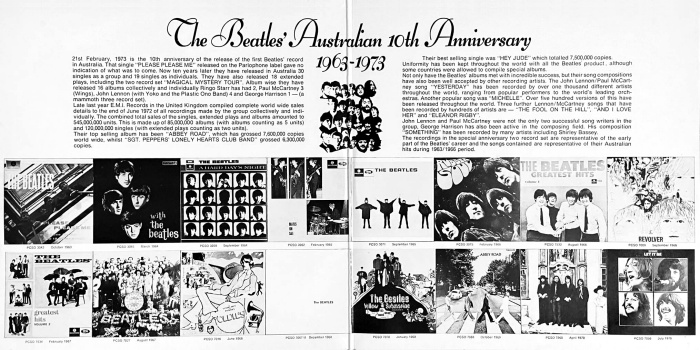
The records also received distinctive lilac/purple labels, normally associated with EMI’s television-promoted double albums, rather than the orange Parlophone labels then used for contemporary Beatles releases. Together with the gatefold and station stickers, they gave this otherwise familiar pairing a recognisably Australian identity. Click the sleeve image above to view the inner gatefold.

Released at $9.00, the package proved to be a genuinely short-lived “limited edition”. The announcement of The Beatles 1962–1966 and The Beatles 1967–1970 soon overtook the local anniversary project, and EMI (Australia) quietly deleted it on 30 June 1973. It nevertheless spent eighteen weeks on the charts, reaching No. 9. Evidence also suggests that a proposed Greatest Hits Volume 3 reached the stage of a track listing being submitted to EMI UK, but no release followed.

The anniversary sleeve notes
The inner gatefold identified 21 February 1973 as the tenth anniversary of the first Australian Beatles release. It counted thirty group singles, nineteen solo singles, eighteen EPs—including the two-record Magical Mystery Tour—and sixteen group albums. Solo album totals were given as two for Ringo Starr, three for Paul McCartney/Wings, four for John Lennon with Yoko Ono and the Plastic Ono Band, and one three-record set for George Harrison.

The notes also reproduced EMI UK’s worldwide sales calculations to the end of June 1972: 545 million units, comprising 85 million albums counted at five units each and 120 million singles, with EPs counted as two units. Abbey Road was named the best-selling album at 7.6 million copies, followed by Sgt. Pepper’s Lonely Hearts Club Band at 6.3 million; 'Hey Jude' led the singles at 7.5 million. The text emphasised worldwide uniformity while acknowledging that some countries had been permitted to compile special albums.

Finally, the notes celebrated the Beatles as songwriters. They claimed more than a thousand recorded versions of 'Yesterday', over five hundred of 'Michelle', and hundreds of 'The Fool on the Hill', 'And I Love Her' and 'Eleanor Rigby'. George Harrison’s contribution was represented by 'Something', with Shirley Bassey cited among its interpreters. The set itself was described as a selection of Australian hits from the early part of the group’s career, covering 1963–1966.