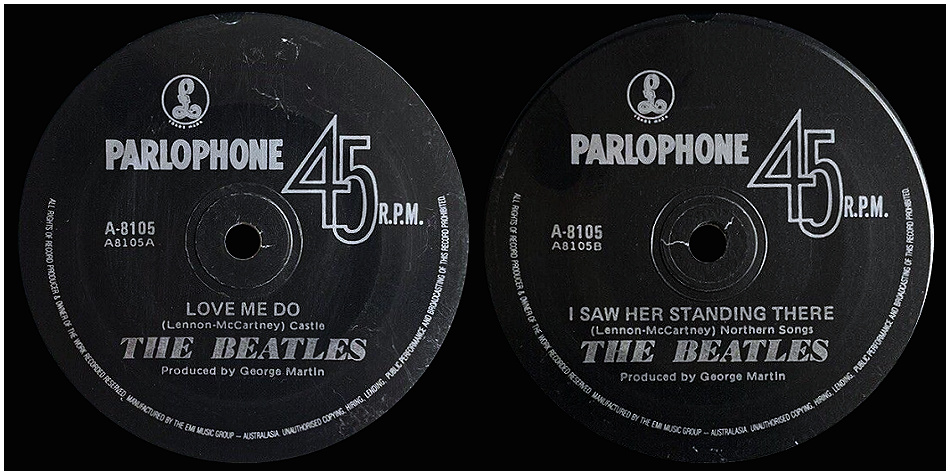
LOVE ME DO / I SAW HER STANDING THERE
Parlophone A8105
Released 16 January 1964
Original recommended retail price: 10/-
EMI (Australia)’s first locally conceived Beatles single paired the group’s previously unissued debut, ‘Love Me Do’, with an album track that Australian radio had already begun turning into a hit.
Matrix Information
Side 1: (mono) 7AXPA650
Side 2: (mono) 7AXPA651

27 June 1976
Side 1: (fake stereo) A 8105 A
Side 2: (stereo) A 8105 B

Overview
Riding the rapidly growing wave of Beatlemania, EMI (Australia) released ‘Love Me Do’/‘I Saw Her Standing There’ on 16 January 1964, its first locally conceived Beatles single.

The record had initially been expected on 23 January, but appears to have been brought forward by a week. Its release on 16 January suggests EMI (Australia) was moving quickly to capitalise on the extraordinary acceleration of interest in The Beatles during the opening weeks of 1964.

EMI (Australia) had originally passed on the British ‘Love Me Do’ single when it was offered in 1962. By the end of 1963, however, circumstances had changed dramatically. ‘She Loves You’ and, particularly, ‘I Want To Hold Your Hand’ had transformed The Beatles into a major Australian attraction, giving EMI (Australia) an obvious opportunity to belatedly add the group’s original British debut single to its Australian catalogue.

Rather than reproduce the original British coupling of ‘Love Me Do'/‘P.S. I Love You’, EMI (Australia) selected ‘I Saw Her Standing There’ from the Please Please Me LP as the flipside. It was a particularly astute choice. Brisbane radio station 4BH had already begun playing ‘I Saw Her Standing There’ directly from the album, and the track entered the Brisbane chart on 14 December 1963 — more than a month before A8105 was released. Its strong local response was therefore almost certainly known to EMI (Australia) and may well have influenced the decision to use it as the new coupling.

Despite this emerging popularity, EMI (Australia) designated ‘Love Me Do’ as the lead side. The most likely explanation is that the release was conceived primarily as the long-delayed Australian issue of The Beatles’ first British single. ‘Love Me Do’ consequently retained the status it had held on Parlophone R4949 in Britain, while the increasingly popular ‘I Saw Her Standing There’ was used as a particularly strong flipside.

There may also have been an additional commercial consideration. ‘Love Me Do’ and ‘P.S. I Love You’ were controlled in Britain by EMI’s Ardmore and Beechwood publishing company and had not formed part of the subsequent publishing agreement between Dick James, Brian Epstein and Leeds Music. Their Australian publishing rights were consequently taken by EMI (Australia)’s own publishing arm, Castle Music — incidentally named after Castlereagh Street in Sydney, where EMI (Australia) was based.

In contrast, ‘I Saw Her Standing There’ was published in Australia by Leeds Music. EMI (Australia) therefore had a direct corporate publishing interest in ‘Love Me Do’ that it did not have in ‘I Saw Her Standing There’. This may have provided an additional incentive to retain ‘Love Me Do’ as the promoted side. There is presently no documentary evidence demonstrating that publishing considerations determined the A-side selection, however, and it is best regarded as a plausible contributing factor rather than the principal reason for the decision.

Whatever EMI (Australia)’s intentions, Australian radio audiences would soon reverse the hierarchy.

The version of ‘Love Me Do’ featured is the later recording featuring Andy White on drums.

Deleted by mid-1970, the single was recut by Richard Mott on 27 June 1976 from PARLO 392/3 — the stereo Please Please Me album cassette production master tapes. Richard’s recut was reissued the following month and remained available until the late 1980s.
Chart Performance

Brisbane

(QLD)

Sydney

(NSW)

Melbourne

(VIC)

Hobart

(TAS)

Adelaide

(SA)

Perth

(WA)

Chart Entry

14-Dec-63

24-Jan-64*

25-Jan-64

24-Jan-64*

18-Jan-64**

17-Jan-64

Highest Position

2

1

1

1

1

1

Weeks In

26

27

27

20

22

16

Listed as "I Saw Her Standing There" except * "I Saw Her Standing There/Love Me Do", ** "Love Me Do/I Saw Her Standing There"

Chart Re-entry

25-Jan-64

-

08-Feb-64

-

-

-

Highest Position

10


3


Weeks In

14


17


Listed as "Love Me Do"

Although EMI (Australia) designated ‘Love Me Do’ as the lead side, it was ‘I Saw Her Standing There’ that became the dominant charting track.


The chart results shown above vividly illustrate what happened after the single reached the shops. ‘I Saw Her Standing There’ had already entered the Brisbane chart on 14 December 1963, after receiving airplay directly from the Please Please Me LP, eventually reaching No. 2. Once the single was released nationally, that preference became much more widespread.


Sydney and Hobart identified the record as ‘I Saw Her Standing There/Love Me Do’, while Melbourne, Perth and Brisbane charted ‘I Saw Her Standing There’ in its own right. Adelaide initially retained EMI (Australia)’s intended order of ‘Love Me Do/I Saw Her Standing There’. ‘Love Me Do’ also achieved separate chart placings in Brisbane and Melbourne, but it was clearly the nominal flipside that generated the greater response.


In effect, Australian radio programmers and record buyers had flipped EMI (Australia)’s single over.


Two months after its release, in early March 1964, Jack Argent, Managing Director of Leeds Music, announced that The Beatles had sold more than 250,000 singles and EPs in Australia since the beginning of Beatlemania — a figure that did not include LP sales. Significantly, Jack identified ‘I Saw Her Standing There’ as the most popular Beatles recording in Australia and expected the single to have sold 50,000 copies before the group arrived in Australia in June.


According to Jack, Beatles recordings ranked by Australian sales at that point were:

  • I Saw Her Standing There
  • I Want To Hold Your Hand
  • Love Me Do
  • She Loves You
  • Twist and Shout

What appears to have begun as EMI (Australia)’s belated Australian release of The Beatles’ original British debut single was therefore transformed by Australian radio and record buyers into something quite different: an ‘I Saw Her Standing There’ hit. EMI (Australia) may have nominated the A-side, but the Australian public effectively chose its own.
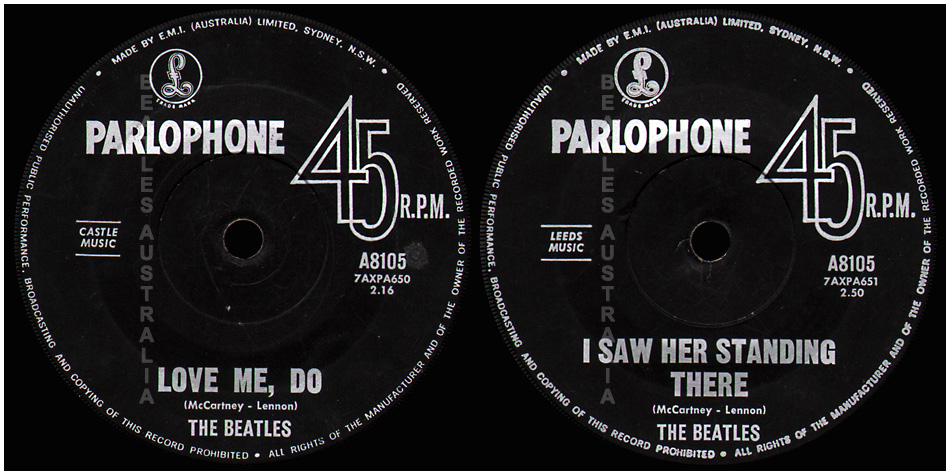
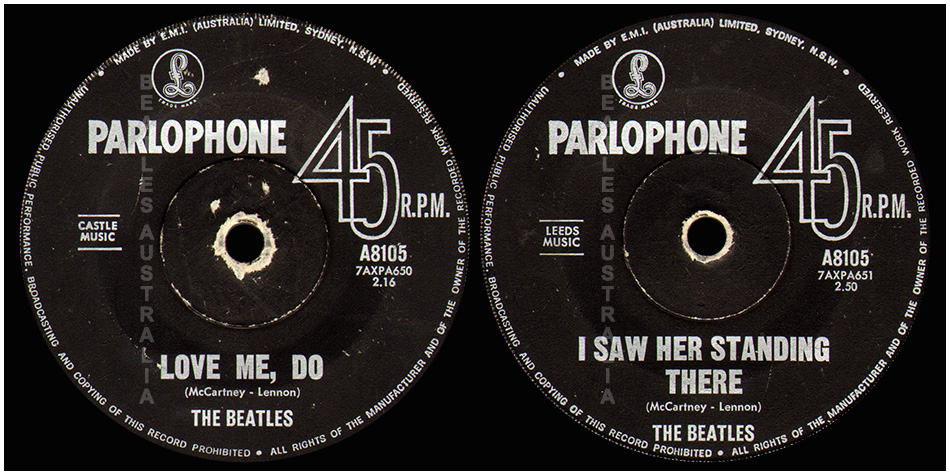
Silver/Black Style 'A'
AUSP8105SBA.a

CASTLE MUSIC / LEEDS MUSIC
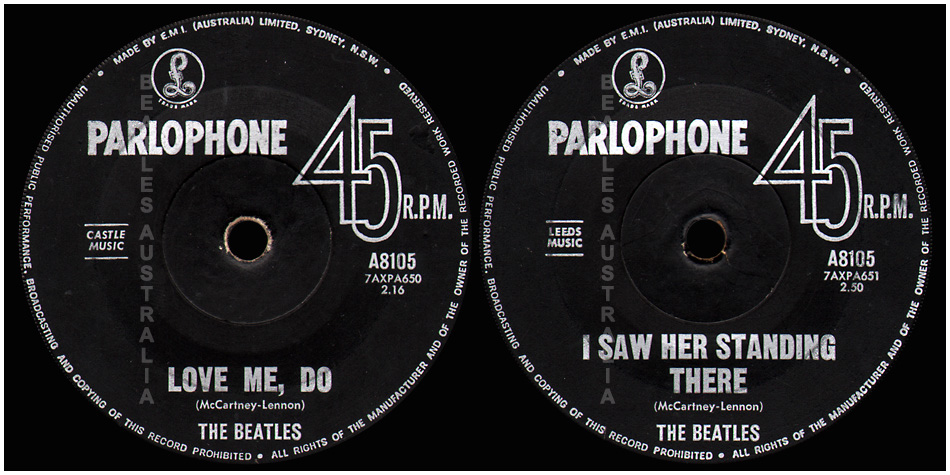
AUSP8105SBA.b

CASTLE MUSIC / LEEDS MUSIC

As per variation 'a' except spacing differences in some non-templated elements
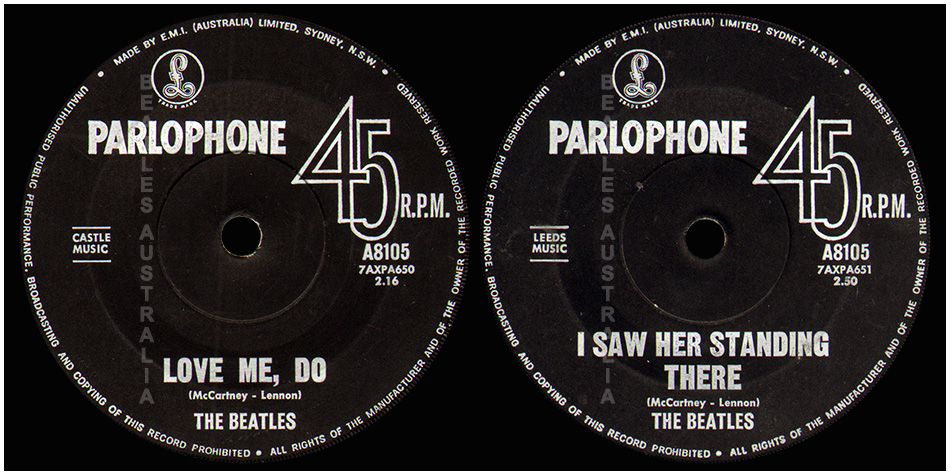
AUSP8105SBA.c

CASTLE MUSIC / LEEDS MUSIC

As per variation 'b' except:
- spacing differences in some non-templated elements
- italicised matrix code & song duration (both labels)
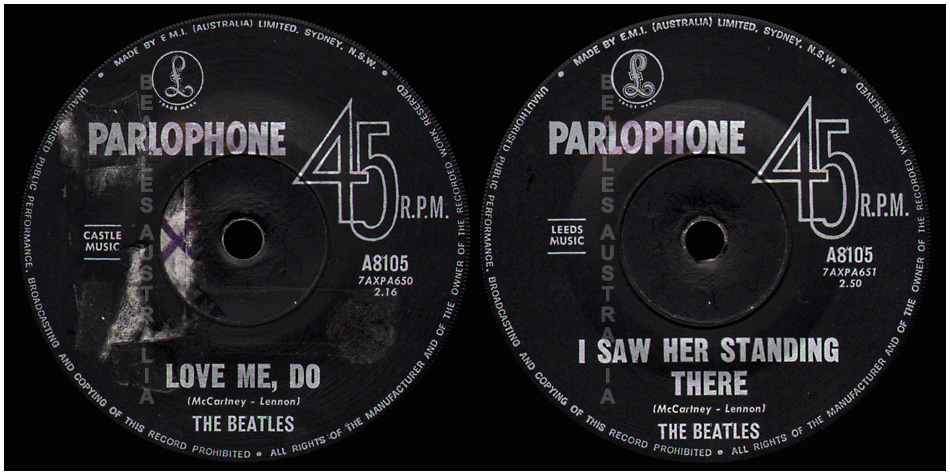
AUSP8105SBA.d

CASTLE MUSIC / LEEDS MUSIC

As per variation 'c' except:
- non-italicised "(McCartney - Lennon)" credit (both labels)
- non-italicised matrix code & song duration (both labels)

Unique element(s) of this label:
- significantly reduced 'leading' gap between 'composer' and
  'artist' credits (B-side)
AUSP8105SBA.e

CASTLE MUSIC / LEEDS MUSIC

Slightly different typesetting of royalty stamp lines
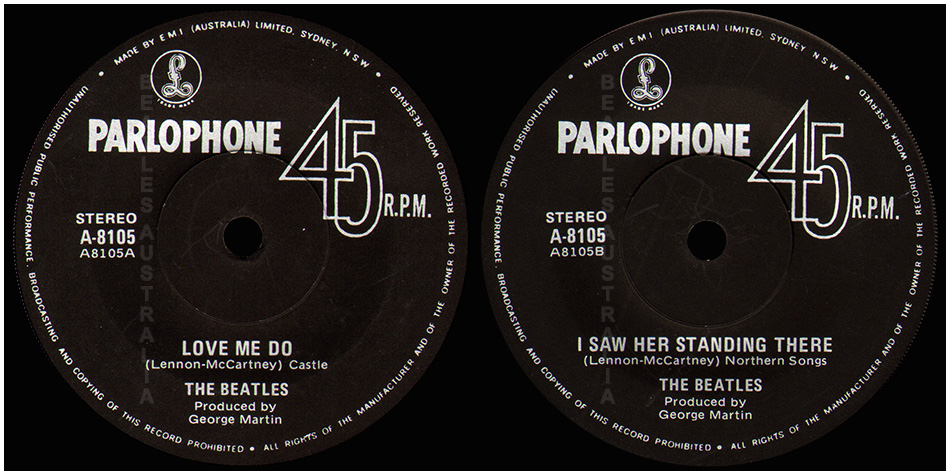
Silver/Black Style 'B'
AUSP8105SBB.a

No comma in "Love Me Do"
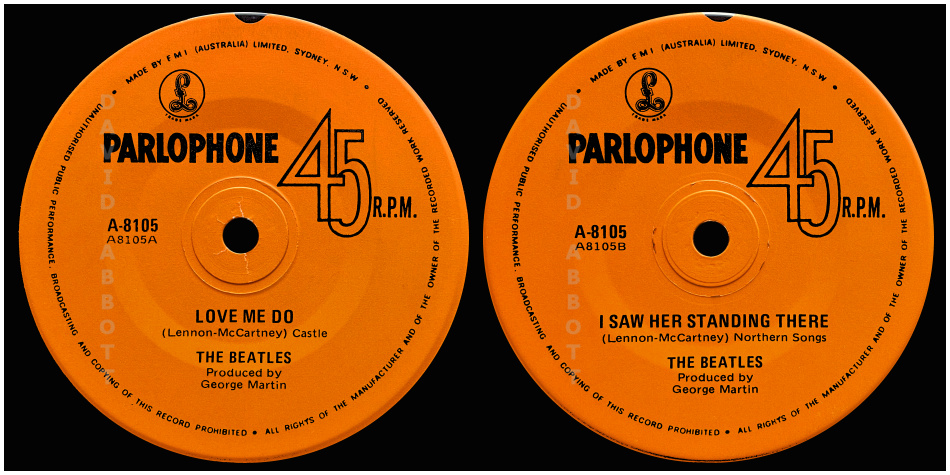
Orange
AUSP8105O.a

As per AU8105SBB.a except:
- no STEREO
- entire label, including template elements, reduced in size
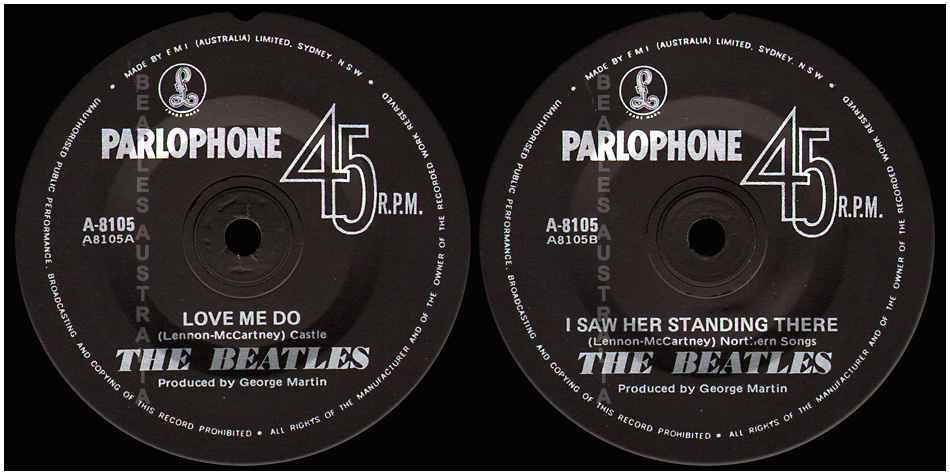
Silver/Black Style 'C'
AUSP8105SBC.a

First appeared in October 1982 with the release of The Australian 20th Anniversary Singles Collection

Visit AB34 for more information or to see an image of the picture sleeve
Silver/Black Style 'D'
AUSP8105SBD.a

As per AUSP8105SBC.a except different spacing between catalogue number block and title block